Training/race report: CIM 2025
tl;dr
Motivation
I never really considered myself a marathon or even really a race person until I started doing long runs (10+ miles) regularly with a run club. This group tended to skew toward more dedicated runners; people were always training for something. Between that and starting to develop my own opinions about training after reading Training for the Uphill Athlete, I decided it was time for me to get off my high horse and stop judging other people by the way they trained when I didn’t even have a race finish to show for myself.
I chose to race CIM because it’s relatively local—ending in Sacramento—and I didn’t want to worry about travel stress on top of race stress. I also liked the timing: it was late in the year, which would allow me to hike the Colorado Trail in the summer as sort of an extended base period and still have time to do an 18 week training period without overlapping with ski season.
Training
Despite having opinions on training, I didn’t really have a great idea on how to structure a training plan. I knew that most of my training would be building aerobic endurance, but didn’t really know how much mileage to run or how to handle speed workouts.
Modern problems require modern solutions: I input my notes from Training for the Uphill Athlete into Gemini, gave it some background on me and what I thought a reasonable time would be, and had it generate a plan based on my notes.
It gave me:1
| Week | Date (Start) | Week Type | Total Miles | Long Run | Key Workouts & Focus |
|---|---|---|---|---|---|
| 1 | Aug 25 | B (Base) | ~30 mi | 14 miles | Base Build 1: Z1/Z2 Aerobic Conditioning. 3x Strength. |
| 2 | Sep 1 | B (Base) | ~33 mi | 15 miles | Base Build 2: Z1/Z2 Aerobic Conditioning. 3x Strength. |
| 3 | Sep 8 | B (Base) | ~36 mi | 16 miles | Base Build 3: Z1/Z2. Drop to 2x Strength as volume peaks. |
| 4 | Sep 15 | R (Recover) | ~22 mi | 11 miles | Recovery Week: 3:1 cycle complete. Absorb fitness. 1-2x Strength. |
| 5 | Sep 22 | B (Base) | 36 miles | 17 miles | Pre-Race Build: Final big run before C-Race. 2x Strength. |
| 6 | Sep 29 | C (Race) | ~33 mi | 13.1 mi Race | C-Race Week: Taper into race. Race (Oct 4) is your quality/long run. |
| 7 | Oct 6 | R (Recover) | ~25 mi | 8-10 mi | Post-Race Recovery: “Lighter week” as you noted. All Z1. 1x Core. |
| 8 | Oct 13 | S (Specific) | ~45-48 mi | 20 miles | Big Build: Introduce Z3 (Tempo) workout. 1-2x Strength. |
| 9 | Oct 20 | R (Recover) | ~40-42 mi | 16 miles | Modulation Week: Step-back in LR to absorb the 20-miler. |
| 10 | Oct 27 | S (Specific) | 50-52 mi | 20-22 mi | PEAK WEEK: Z4 intervals 6x800. 1x Strength. |
| 11 | Nov 3 | R (Recover) | 40 miles | 14 miles | STEP-BACK WEEK: Absorb peak fitness. Maintain one Z3 workout. |
| 12 | Nov 10 | B (Race) | ~35-40 mi | 13.1 mi Race | B-Race Week: Taper into race. Race (Nov 16) as tune-up. |
| 13 | Nov 17 | T (Taper) | ~32 mi | 10-12 mi | Taper 1: Recover from half. 1x Core strength. All easy. |
| 14 | Nov 24 | T (Taper) | ~25 mi | 8 mi | Taper 2: Continued volume drop. Optional short Z3 “strides.” |
| 15 | Dec 1 | G (Goal) | ~15-20 mi | 26.2 mi Race | RACE WEEK: Short Z1 “Recovery workouts” only. CIM on Sun! |
During my initial training build up, I also kept three strength days in the gym, but ended up dropping those when my mileage started ramping up in October. I also continued playing hockey roughly once per week.
Gemini did not really tell me how long my runs should be outside of my long run distance and some speed workouts. My non-long runs ended up usually being around 8 miles (13 km), with a few shorter runs to get to desired weekly mileage. All of my runs except for the speed workouts I did at Z2 pace (trying to keep my heart rate < 150 bpm): which is around 9:45 minutes/mile (6:00 min/km) for me. I would also run up and down some hills I live by about once per week.
Overall, this plan went pretty well, with two issues:
- Heart rate scare: I got into a small bike crash on October 19th. Fortunately, I managed to escape with only some minor scrapes. However, I noticed that my heart rate was much higher the week after for easy runs—I was seeing it go up to 170 bpm. I eventually figured out that this was due to bad readings from my chest strap heart rate monitor, and it returned to normal after I reset it.
- Tightness in my calf: After my peak week long run of 22 miles on a Saturday, I went out the next day to complete my weekly distance. A couple miles into the run, my right calf started to tighten up, and did not improve during the run. Knowing that the golden rule of training is to not get injured, I didn’t run on Monday, but then did my scheduled speed workout on Tuesday, where the tightness returned and got worse. I took three days completely off from running, and by the next Saturday, my calf felt much better, and didn’t give me any more issues the rest of the training block.
I ended up dropping a bunch of volume that week due, but other than that and a 25 mile day hike in the Adirondacks that I threw into my plan on a “recovery” week, I stayed very true to it.
Strategy
Coming into this training block, I guessed that I would be able to run a marathon somewhere between 3:30 and 4:00, with 3:30 seeming pretty aggressive, and 4:00 feeling somewhat conservative. I figured that I’d see how I felt during my training block and pick a more precise goal time based on that.
Critical to this was racing the Berkeley Half. Since my speed workouts had felt very inconsistent, with some workouts that I thought would be hard feeling easy and others that I thought would be easy feeling hard, I figured Berkeley would give me a nice check-in. After running 1:41:45 and feeling like I had more to give, I decided to set my sights on the aggressive goal of a 3:30 marathon, despite both Strava and Garmin casting doubt on my ambitions.
Strava: 
Garmin: 
From talking to other people who had raced CIM in the past and studying their splits, the strategy was very clear to me: DO NOT GO OUT TOO HARD. While CIM is net downhill, the first half has rolling hills, which can take a toll on your body and cause you to lose out on running fast for the relatively flat second half.
With this in mind, I put together the following PacePro plan, using my typical style of racing, which is taking the uphills easy, the downhills a little faster, and overall relying on negative splits to take advantage of the fast second half of the course. Roughly, I suspected this would correspond to following the 3:35 pace group for the first half of the course and trying to catch up to the 3:30 pace group in the second half.
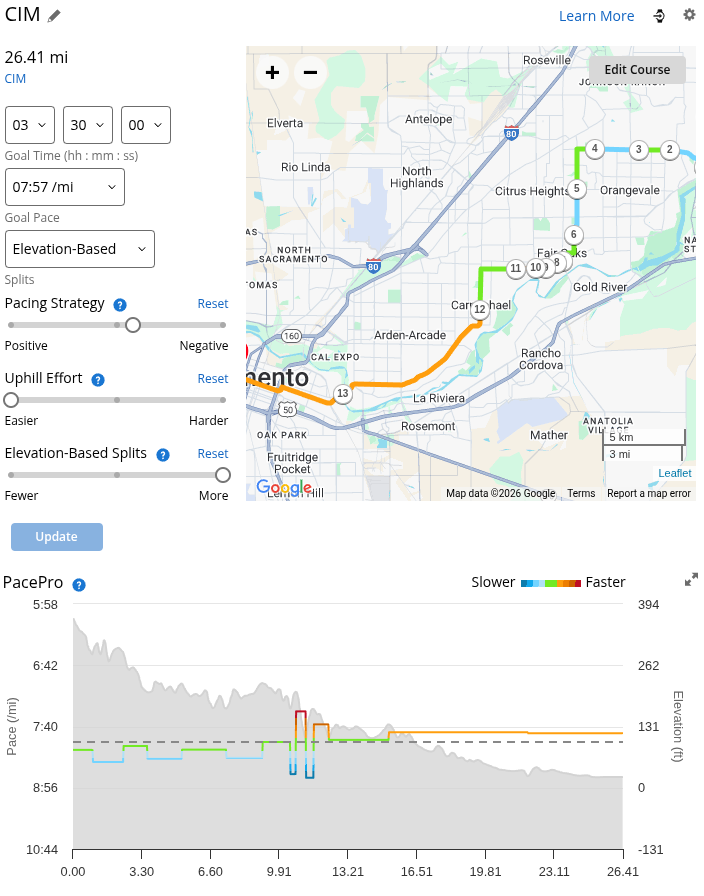
I still was not entirely confident in this plan though. I’d heard the marathon described as a 10k race with a 20 mile warmup, and I had no idea how I’d feel that late in the race. On the other hand, a sub-3:30 marathon was a tantalizing goal that I didn’t want to give up.
Race Weekend
Saturday
In one of these races I swear I will figure out the logistics well enough that I won’t be stressed. It was not this one.
This was somewhat self-inflicted. I did a shake out run on the Embarcadero before picking up my rental car, and then realized I didn’t have my license when I got to the counter. They did not accept my mobile drivers license. This cost me at least a half an hour of going back home, picking up my license, and returning.
This meant I also left later (14:00) and therefore hit more of the persistent bay area traffic on the way to Sacramento. Fortunately, I had a buffer to pick up my bib and packet before the expo closed, but navigating here was also not easy: the expo was at the California State Fair, but just using that name for navigation brought me to a road that was closed. The next entrance was also closed. The instructions in the email did say where to enter, but it would have been nice for the organizers to provide a link to that specific entrance or better name for navigation.
After bib pickup, I met a few members of my run club in downtown Sacramento. One other member and I attempted to find some pasta, but the wait was too long at the ramen restaurant near the bar where the meetup was. We ended up eating at the hotel he was staying at. My meal was fine, but a bit small.
Sunday morning
I would not say I got great sleep the night of the race, but I wasn’t really expecting to. I was more excited than nervous, since I knew I would feel fine at least through the half, and after that I’d be too in the zone to be nervous anyway, but the pre-race anxiety still made it hard to fall asleep or sleep deeply at all.
Further adding to my stress was the fact that CIM only allows arrival by race-provided bus at the start line. I stayed at Point West, where the buses were supposed to depart by 5:00am sharp. I’m not sure I even needed an alarm because I was sleeping so lightly, but after getting dressed, having my yogurt and oreos (still looking for a better pre-race meal), and checking out of the hotel, I was comfortably ten minutes or so early. I didn’t need to worry. There was still a long line of racers boarding the buses around 5:00 when mine departed.
We arrived at the start line at 5:50. Not really sure what I was supposed to do for over an hour before the race started, I stayed on the bus until 6:25. It was cold and dark outside and it didn’t seem necessary to leave earlier.
I should have gotten off the bus earlier. Despite CIM’s boast of “the lowest runner to porta-potty ratio at any major race in the country” (30 to 1), the line for the porta potties did not move fast. I waited at least 20 minutes in line, and ended up running farther down the line of porta potties to another one to go just as the corrals were starting to close.

For those keeping track, I’m 2/2 on not leaving enough time to pee before road races.
This meant that I wasn’t able to line up with my pace group and had to filter in from the side. I had dumped my warmup clothes by this point and was so full of adrenaline that I wasn’t even really cold to start the race. My heart rate was 160 bpm before I even crossed the start line.
The race
I’ve heard that the first six miles of a marathon should feel like you’re walking. Given that I was starting off at a slower pace than I ran during my half, which felt very comfortable, I was pretty confident I would feel this way through at least the first half.
I did not. In fact, less than 10 km in, I was hungry, my legs were feeling heavy, and my heart rate was in the 160s despite holding myself to within 25 seconds of my intended pace plan. Unfortunately, at this point, it didn’t really seem like there was much I could do. I wasn’t ready to let go of the goal of 3:30, but mentally prepared myself for really having to push myself hard in the second half of the race or slipping to a 3:40+ marathon.
I ran a 1:47 first half, basically dead on with my plan. Around mile 16, though, I saw a 180 bpm heart rate reading for the first time. I know I can run in the 180s, but usually I have to push myself to sustain this intensity, and I was hoping not to have to do this until the final 10 km, when I was ready to leave everything on the course. On the other hand, I didn’t feel like I was pushing myself too hard yet despite naturally increasing my pace.
I decided to switch off the heart rate screen on my watch to my pace screen and just run by feel, hoping that I had chosen a sustainable pace to get myself through the infamous mile 20 “wall” and to the end.
To my surprise, my pace kept naturally increasing, and while I felt lactic acid building up in my legs, I never felt like I was pushing too hard. As the miles passed, my confidence grew that I could hit my 3:30 target, especially as my watch began to show me I was pulling ahead of my PacePro goal time. I stopped holding myself back as I got closer to the end, figuring around mile 18 that if nothing had catastrophically failed at that point, I’d probably be okay.
Perhaps most satisfying around this point was that I was starting to consistently pass people. While starting with the wrong pace group in Berkeley cost me in that I had to dodge other runners the whole race, gradually picking people off after choosing the right pacing strategy was immensely rewarding, and the cherry on top was finally catching back up to the 3:30 pace group after I had started the race around the 3:45 pace group.
I finished in 3:25:00; running the second half in 1:37, ten minutes faster than my first half and almost five minutes faster than my Berkeley Half time.
Aftermath

Most noticeable to me after the race was how tired my legs were. While I had some fatigue during training after long runs, the lactic acid buildup was not something I’d ever experienced while training. I also had some soreness on my waist just under my belly button. At first, I thought this was also from lactic acid, but I wonder now if it was a pressure point from the half tights I was wearing.
Surprisingly, I also had some soreness in my arms.
While I smiled at several of the signs along the way saying things like “toenails are temporary, the marathon is forever” or something, the signs had the last laugh. Two of my toes were not treated well by my shoes, despite my attempts to tape away my toe problems. Fortunately, both those toenails look like they’re going to make it as of this writing.
Race retrospective
What went well
- Starting closer to the right pace group made this experience a lot less frustrating.
- I did not blow up at mile 20, or in fact anywhere on the course.
- I ran strongly negative splits.
- Race fueling and hydration: I finished my gels and drank my water. I was glad not to have to stop at the aid tables.
What could have gone better
- I still did not leave enough time to go to the bathroom before the race. I should have gone down to a farther porta-potty from the start, where lines were shorter.
- I didn’t really feel great. My legs were heavy and I felt hungry.
- My shoes pressed weirdly on my toes.
Where I got lucky
- Close to ideal racing weather: low 40s and cloudy.
Training retrospective
These past few months are the first time I’ve trained specifically for running in my off-and-on running career. It was fun and rewarding doing this! While I’m glad I’ll be able to pick strength training up again and not let my upper body totally wither away, I’d be interested in running another marathon at some point, since I think there’s still a lot of room for improvement.
Specifically, I think there are a lot of ways to iterate on my training. What’s the correct weekly volume? What should the composition of weekly volume be? How should I structure my speed work? What’s the correct amount of speed work? Should I try a shorter taper given that I felt so much better at Berkeley vs. CIM?
Likewise, my nutrition is a bit inconsistent. I know my pre-race morning meal is not great, and I don’t think I ate an ideal dinner the night before, but I also think there’s room to experiment with my carb intake while running. Carbs consumed by elite level athletes keep going up, so I’d like to see what my stomach can tolerate.
I suspect my pacing isn’t optimal either. While I was happy to run negative splits, my splits were so strongly negative (1:47 first half vs. 1:37 second half) that I suspect I left a lot on the table in the first half. Running more even splits would likely be faster overall.
Looking forward
When I first finished the race, I was elated with my time: I hit a goal that I thought would be rather aggressive when I first started training even though I didn’t feel like I ran a great race.
With a few weeks of hindsight, I’m now looking toward the future. What would be a good time for me in the marathon? Dan Luu’s essay “95%-ile isn’t that good” informs a lot of my thinking on how to compare myself to others. While I’m not sure this essay applies entirely to running, which is a sport without “practice” so much as “training” and is already very numbers-oriented, it seems like a reasonable benchmark. Based on this distribution, while I’m safely in the top quartile of marathon finishers for men under 35—my age group—a 95%ile finish in the marathon is … about 2:50. That’s very fast.
This is exactly the interesting part about road marathons, though. While I don’t find the scenery really compelling and I’d prefer a bit more solitude over the constant crowd noise, they serve as a great benchmark for your training and preparation. There’s no winging a marathon, but the reward for the continued investment is what keeps true runners coming back.
-
A Gemini bug caused the original training plan the model gave me to be deleted. I attempted to reconstruct it to the best of my ability from my memory and training history. ↩

